Create your class
Choose a 4- or 8-quarter format, create teams and share private access with your students.

MARKUP MARKETS FOR EDUCATORS
Turn business theory into competitive decisions. Student teams manage companies inside the same evolving market while you control the pace, review their reasoning and turn every quarter into a classroom discussion.
FROM ZERO TO CLASSROOM IN MINUTES
No installation, purchasing process or lengthy instructor onboarding. Create a class, let students learn the environment in practice, then move into official competition when you are ready.
Choose a 4- or 8-quarter format, create teams and share private access with your students.
Students complete a disposable round so interface learning does not interfere with assessed performance.
Process the market, review outcomes with the class and connect student reasoning to what actually happened.
PRACTICE BEFORE PERFORMANCE
A new interface should not be the hardest part of a business simulation. Academic Mode lets you begin with a complete disposable Practice Round, discuss what happened, then reset every team cleanly before official Quarter 1.
INSTRUCTOR CONTROL
Academic Mode is designed around the instructor's workflow, not just the student's game screen.
See Not Started, In Progress, Submitted and Late teams at a glance.
Open and close decision windows, set deadlines and move on when the class is ready.
Allow corrections when appropriate while preserving a decision and activity history.
Process a quarter first and decide when students should see the result.
Distinguish a team that has not begun from one actively working through decisions.
Use PDF, XLSX and CSV records for assessment, review and post-simulation analysis.
PRINTABLE REPORTS & ASSESSMENT EVIDENCE
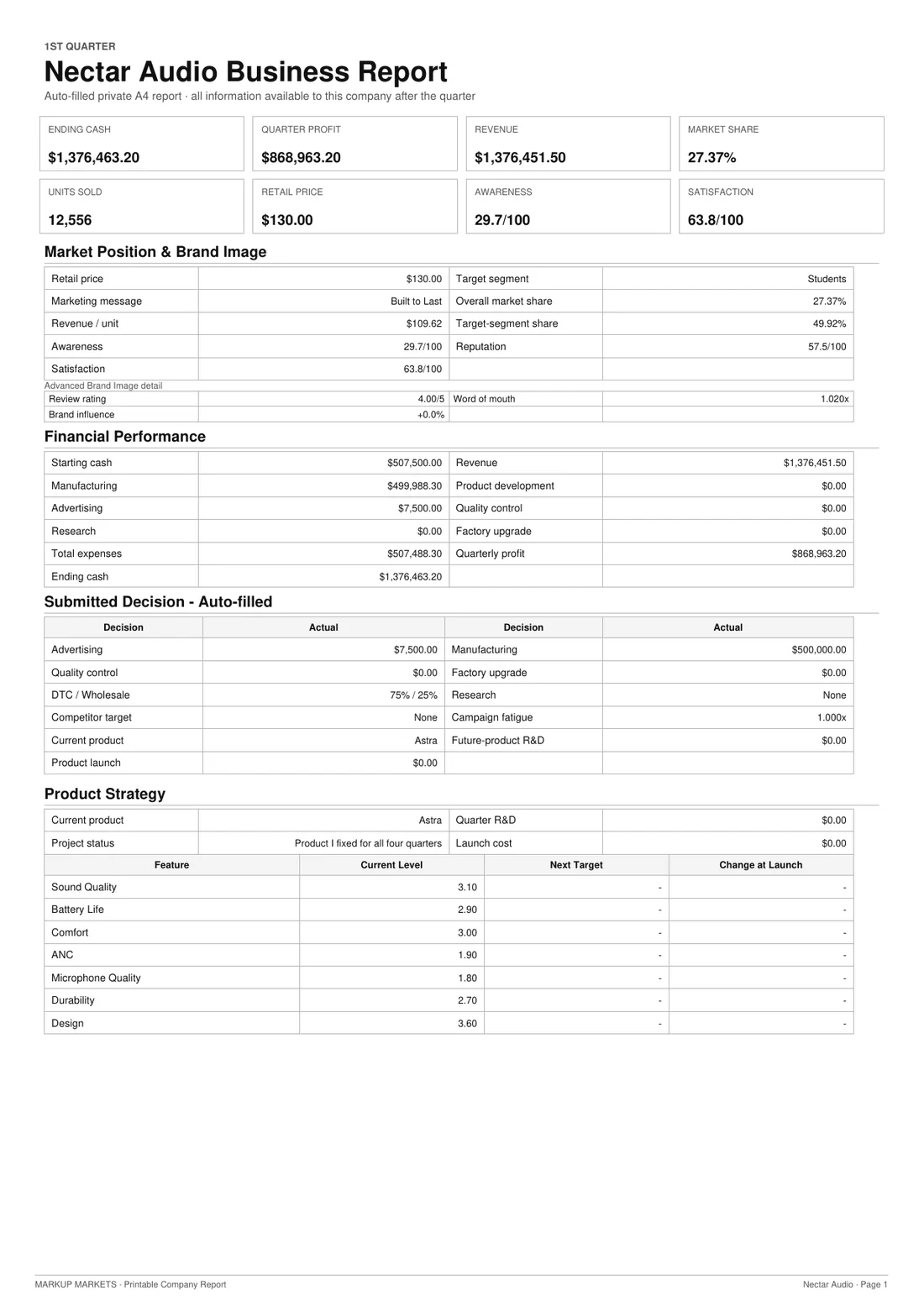
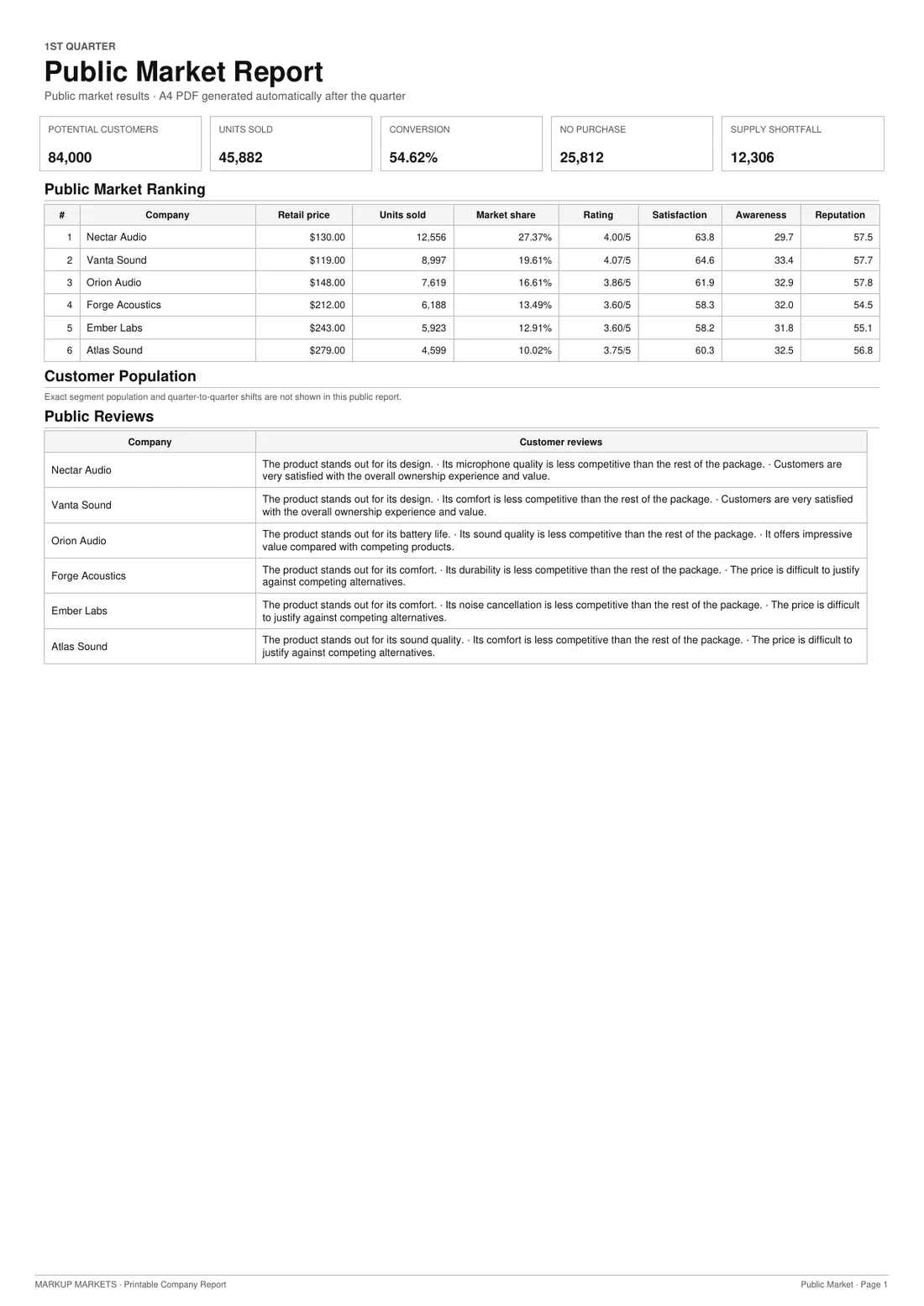
Markup Markets can turn each processed quarter into printable records that students and instructors can use for debriefing, assessment and reflection. These are actual Quarter 1 examples generated by the simulation.
The private report combines financial performance, market position, submitted decisions, product strategy, manufacturing and quality, segment performance, customer experience, break-even analysis and decision analysis in one A4 document.
The public report gives the class a shared view of potential customers, units sold, conversion, supply shortfall, market rankings and customer reviews while deliberately withholding exact segment population and quarter-to-quarter shifts.
TEACH FROM WHAT STUDENTS ACTUALLY DID
Winning the simulation is not the only learning outcome. Instructor analytics, presentation views, decision history and management rationale make student choices discussable.
ONE MARKET. CONNECTED BUSINESS DISCIPLINES.
Identify meaningful customer differences and decide which segments deserve attention.
Build a coherent relationship between product, customer, price and brand.
Balance margin, demand, market share and competitive response.
Allocate advertising resources and evaluate whether spending creates enough demand.
Estimate demand under uncertainty and translate expectations into operational choices.
Experience the cost of both stockouts and excess inventory.
Decide when more information is worth purchasing and how much confidence to place in it.
Connect revenue, cost, investment and profitability rather than optimizing one metric.
Revise strategy when outcomes and competitor behavior challenge prior assumptions.
DESIGNED TO FIT YOUR COURSE
The instructor controls the pace. Markup Markets is strongest in marketing and introductory business courses, but the same competitive market can support several teaching formats.
INSTRUCTOR GUIDE
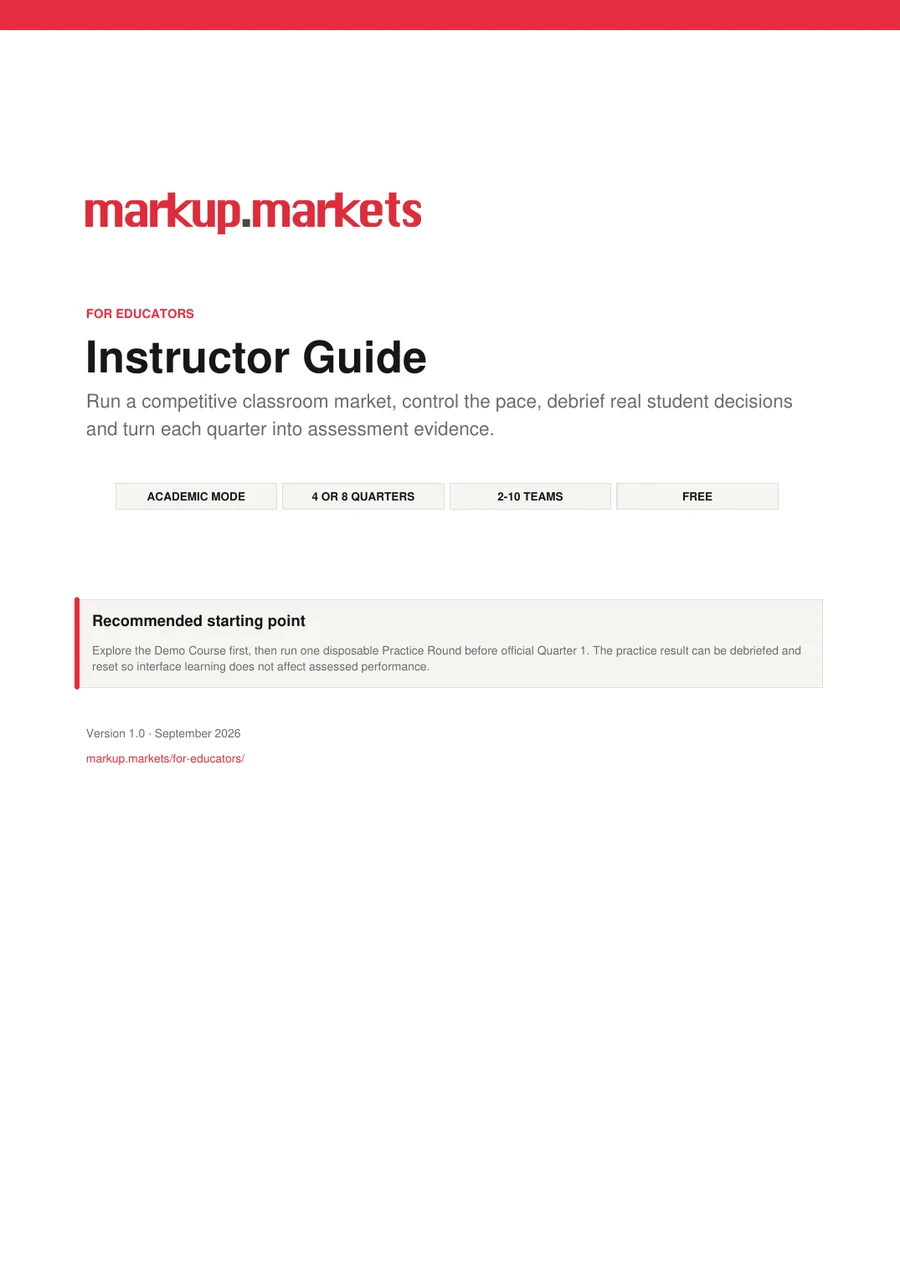
The printable guide walks through classroom setup, learning objectives, the Practice Round, instructor controls, debriefing, teaching formats, assessment, reports, troubleshooting, privacy and a one-page quick checklist.
SIMULATION METHODOLOGY
A classroom simulation is useful only if reasonable strategies create meaningful trade-offs. Markup Markets is tested across deterministic computer-run markets and deliberately extreme strategies to identify unstable mechanics and obvious exploits.
WHY MARKUP MARKETS?
| Classroom requirement | Markup Markets | Typical commercial workflow |
|---|---|---|
| Student cost | Free | Often licensed per student or team |
| Instructor evaluation | Immediate demo | May require sales or demo process |
| Installation | None | Varies |
| Practice round | Built in | Varies |
| Instructor controls | Included | Usually included |
| Reports & exports | PDF / XLSX / CSV | Usually included |
BEFORE YOU USE IT WITH STUDENTS
Markup Markets is actively being developed and is currently seeking feedback from educators and early classroom users. We would rather make that clear than pretend to be a decades-old institutional product.
Ask us a question →Yes. There are currently no student license fees or institutional purchasing requirements.
Yes. The populated instructor demo exists specifically so educators can explore Academic Mode before involving students.
No. Markup Markets runs in a modern web browser.
Yes. Academic Mode supports multiple students per company, with 2–10 competing companies in a class.
Yes. Decision submission, quarter processing and result release are separate instructor-controlled stages.
Yes. Academic reporting supports downloadable records including PDF and spreadsheet-compatible exports.
EARLY EDUCATOR PROGRAM
We are looking for marketing, business and strategy educators willing to explore the simulation and tell us one thing: what would prevent you from using this in your course?
PUT YOUR STUDENTS IN THE MARKET